Insomniotters · 2026

The Book of Pachi

He merely floated

There are four Books. Three survive more or less intact. The fourth is the one everybody argues about — and it is the only one that really matters, because it is the one that explains how to leave.

The Four Books

The received text

What follows is the Keepers’ ordering, which not everybody accepts. It is, however, the ordering we use, and this is our tent.

Three of the four Books mark a station of the Cycle — the waking, the unlearning, and the Travel. Those are the windows set beside them. What the Temple actually celebrates is not one life but the turning, and we observe it once a year, compressed into a week, in the dust.

  1. Book the First: The Origin Spring

    Pachi is conceived in water and grows up in it, in the spring that gives the Book its name. They are not alone. There is the Cave Child — a companion the Keepers can name but whose nature they have never agreed on — and for a time the two are inseparable.

    Then the storm. It tears them apart, and Pachi is driven out of the water and into the Land world: bewildered, soaked, and entirely unprepared. There, for the first time, Pachi begins to experience things.

    The Resurrectionists hold that this is not a birth at all. See the Schism, below.

    Stained-glass panel: a haloed otter sits upright in a green clawfoot bathtub filled with deep red liquid, beneath a gothic arch on a cobalt blue ground.
    I · The Waking They arrive in the water
  2. Book the Second: The Many Worlds

    Pachi travels. Pachi tastes, endures, and passes through a great many worlds — more of them than the Keepers have managed to catalogue. Somewhere in the middle of all this, Pachi begins to feel that they have understood the pattern.

    By the closing pages Pachi is no longer merely knowledgeable. Pachi is certain — and certain, further, that this certainty is owed to everybody else. The Book ends on a fully formed savior complex.

    The Keepers describe Book the Second as the most relatable of the four.

  3. Book the Third: The Edge Cases

    Pachi teaches. Pachi preaches. And one by one the world produces situations the teaching does not cover — the exception, the person who does not fit, the case for which the doctrine has no answer. The Keepers call these the edge cases, and Book the Third is largely a record of them accumulating.

    It does not end in triumph. It ends with Pachi doubting every single thing they had been certain of.

    In the theology of this Temple that collapse is not a failure but the beginning of Transcendence. You cannot travel anywhere while you still believe you have arrived.

    Stained-glass panel: a pale skull fills a rose window above a dark violet forest. An otter lies still in blue water below, watched from the bank by five silent otters.
    II · The Unlearning They slip beneath
  4. Book the Fourth: The Lost Book

    Most of it is gone. What survives exists as scattered pages held by rival factions, each of which insists its own fragment is the complete and operative text. The Keepers hold the largest collection and decline to say how large.

    Every surviving fragment agrees on one thing: Book the Fourth contains the key to Transcendence, and to Travel — the passage between worlds. What the fragments do not agree on is the price.

    • One reading The way opens only through blood sacrifice.
    • Another The way opens only to those who abandon every material possession.
    • A third There is no price. The asking is the barrier.

    The complete text is disclosed to initiates in stages, in an order the Keepers determine, upon terms the Keepers set. We are assured this is for our own protection.

    Stained-glass arched window: a haloed otter in red robes ascends above a forest stream, hands clasped, watched from below by a fox and a hare.
    III · The Travel They rise, and go on

The Schism

Two readings, one text

Some factions say Pachi dies at the end of Book the Fourth, at the very moment of learning to Travel. Everything else follows from what you believe happened next.

Our position

The Resurrectionists

Book the First is not a birth. It is The First Resurrection — and not the first of anything, only the first one anybody wrote down.

Pachi lives and re-lives the Cycle without end: waking naive, discovering, preaching, unlearning, and at last Travelling on. Then waking naive again, somewhere else, remembering none of it. Death at the close of Book the Fourth is not an ending. It is a door.

The Temple of Insomniotters is Resurrectionist. It is why we hold The Resurrection on Thursday, and why our week runs the way it does.

The other position

The Singularists

One life, lived once. No cycle, no return, no repetition.

The Pachi of the Origin Spring is the same Pachi who learned to Travel at the end of Book the Fourth — and that Pachi did not die. They simply left. They are out there now, still going, world to world, and have not once looked back at any of us.

We think they are wrong. We serve them gazpacho anyway.

Which one are you?

You have now read both positions. The Keepers maintain a questionnaire for the undecided — answer honestly, and it will tell you where you stand. The result is not negotiable.

Take the Faction Alignment Quizopens in a new tab

The Library of the Keepers

Holdings, partially disclosed

The Keepers preserve the one true text of Pachi. They are the translators and the cataloguers — the ones who decide which page is canon, which is apocrypha, and which is a forgery. They also keep the history of the faith itself: every schism, every faction, every fragment and who holds it.

The Library holds the artifacts. Three leaves are reproduced below in full, with their scripture transcribed beside them. What else the Library holds is not published, and asking does not help.

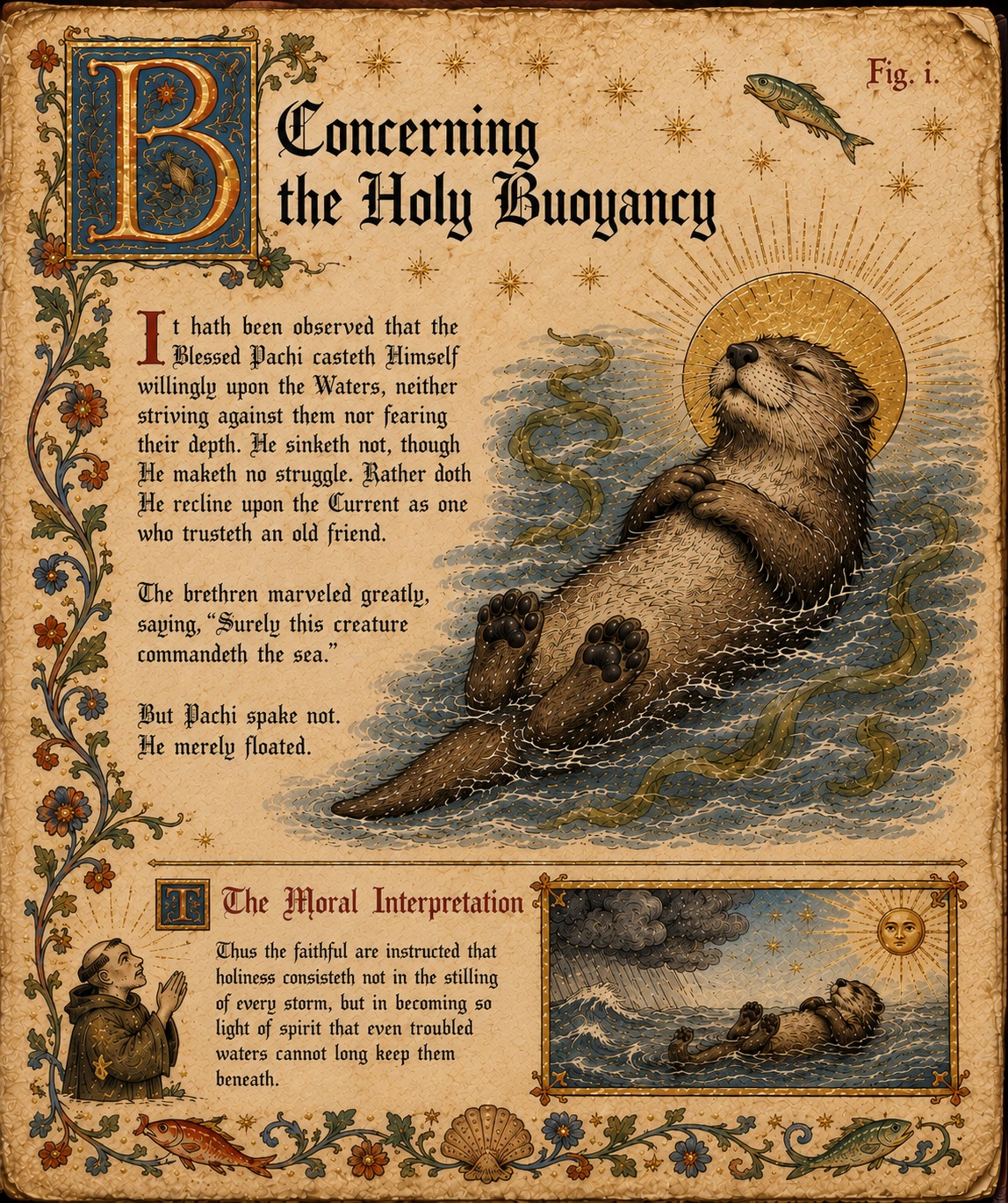
Illuminated manuscript plate on aged parchment. A haloed otter floats on its back in stylized blue water among kelp fronds, paws folded on its chest. A floral border runs down the left margin; a small inset below shows the same otter floating calmly between a storm cloud and a smiling sun.
Fig. i — Concerning the Holy Buoyancy View full size

Fig. i

Concerning the Holy Buoyancy

It hath been observed that the Blessed Pachi casteth Himself willingly upon the Waters, neither striving against them nor fearing their depth. He sinketh not, though He maketh no struggle. Rather doth He recline upon the Current as one who trusteth an old friend.

The brethren marveled greatly, saying, “Surely this creature commandeth the sea.”

But Pachi spake not. He merely floated.

The Moral Interpretation

Thus the faithful are instructed that holiness consisteth not in the stilling of every storm, but in becoming so light of spirit that even troubled waters cannot long keep them beneath.

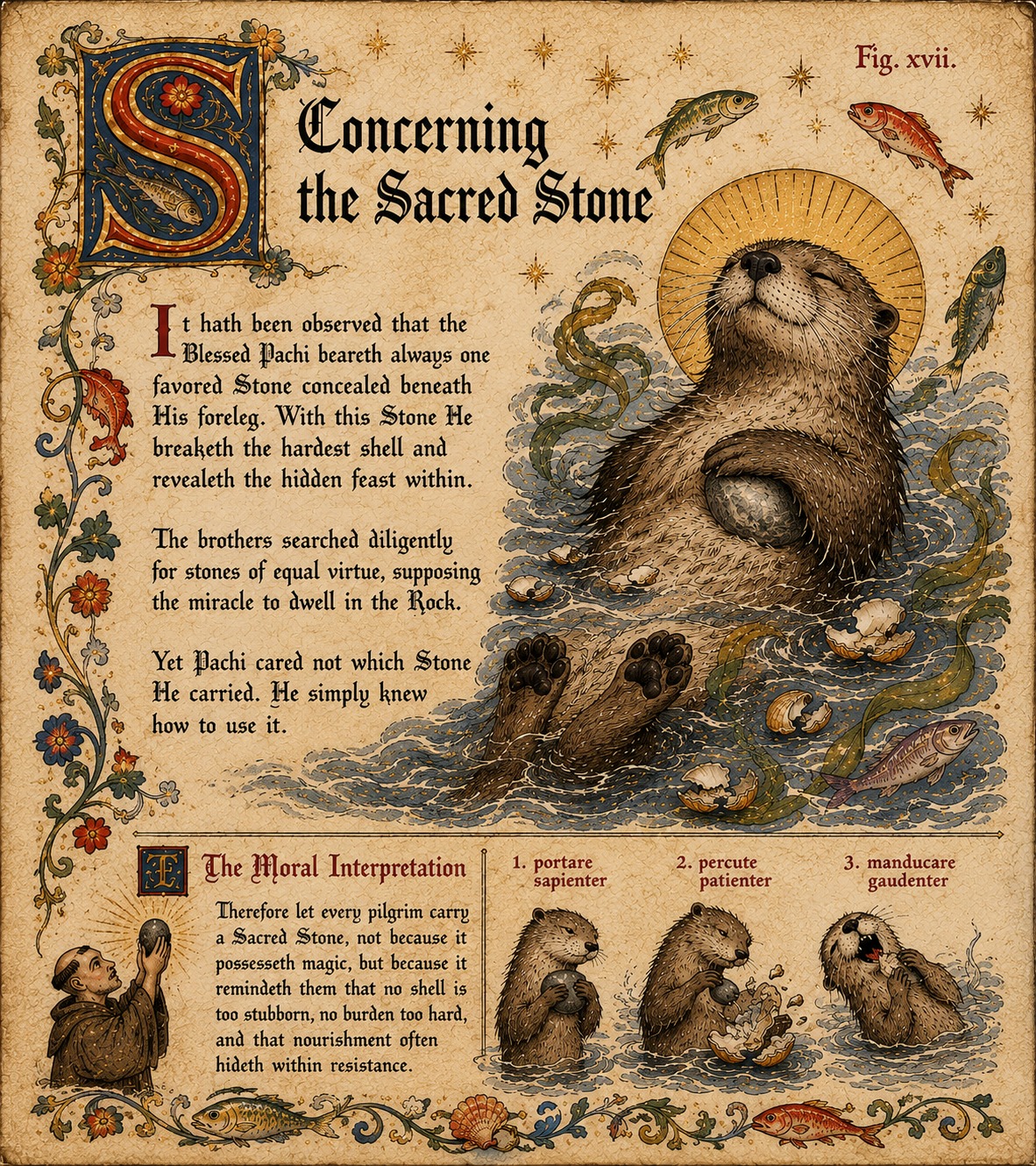
Illuminated manuscript plate on aged parchment. A haloed otter floats on its back holding a grey stone against its chest, surrounded by fish, kelp and cracked shells. Below, three small panels show an otter carrying, striking, and eating from a shell.
Fig. xvii — Concerning the Sacred Stone View full size

Fig. xvii

Concerning the Sacred Stone

It hath been observed that the Blessed Pachi beareth always one favored Stone concealed beneath His foreleg. With this Stone He breaketh the hardest shell and revealeth the hidden feast within.

The brothers searched diligently for stones of equal virtue, supposing the miracle to dwell in the Rock.

Yet Pachi cared not which Stone He carried. He simply knew how to use it.

The Moral Interpretation

Therefore let every pilgrim carry a Sacred Stone, not because it possesseth magic, but because it remindeth them that no shell is too stubborn, no burden too hard, and that nourishment often hideth within resistance.

  1. i. portare sapienter to carry wisely
  2. ii. percute patienter to strike patiently
  3. iii. manducare gaudenter to eat joyfully
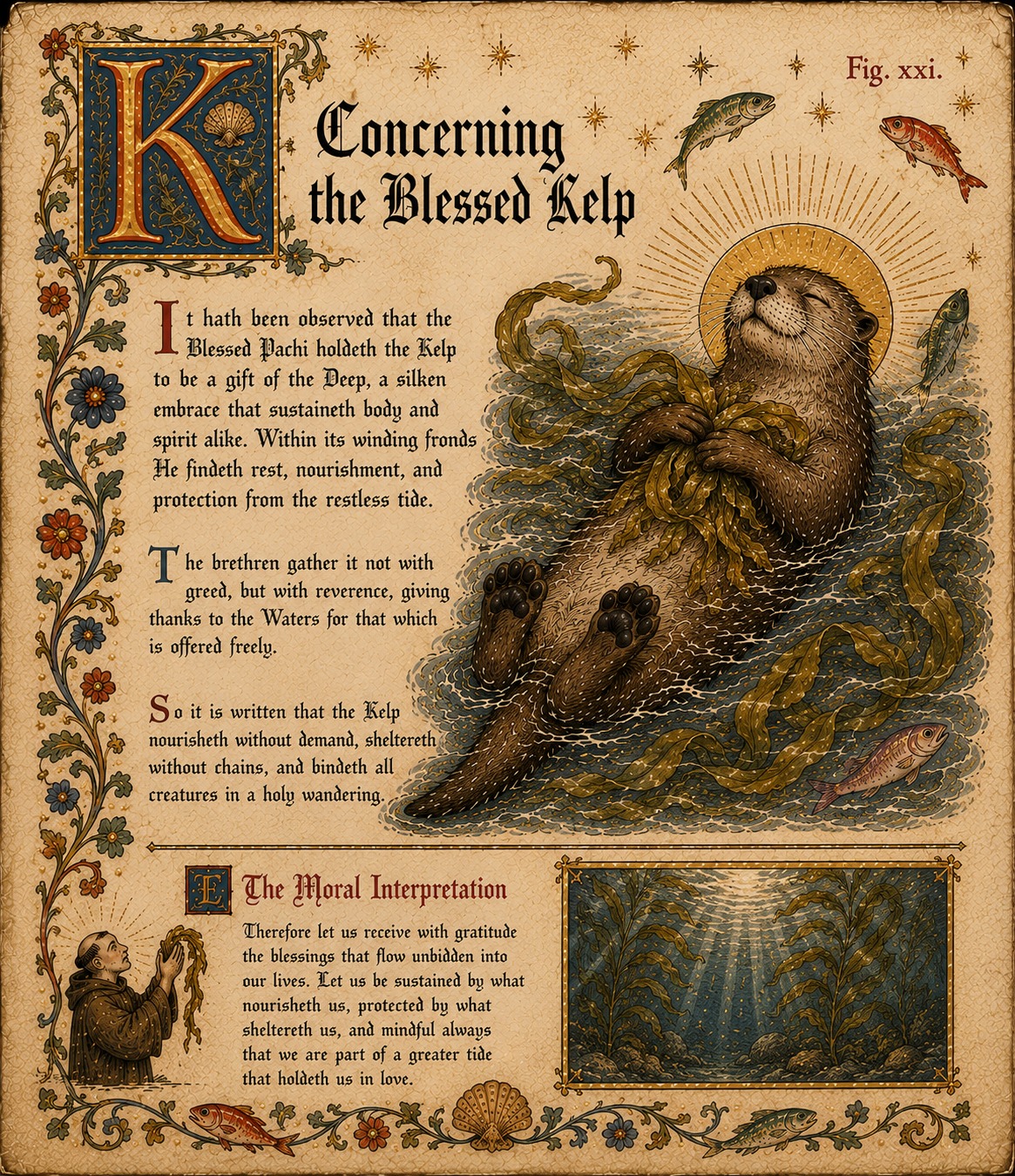
Illuminated manuscript plate on aged parchment. A haloed otter floats on its back clutching a bundle of golden kelp to its chest, wrapped in winding fronds. A small inset below shows a sunlit underwater kelp forest.
Fig. xxi — Concerning the Blessed Kelp View full size

Fig. xxi

Concerning the Blessed Kelp

It hath been observed that the Blessed Pachi holdeth the Kelp to be a gift of the Deep, a silken embrace that sustaineth body and spirit alike. Within its winding fronds He findeth rest, nourishment, and protection from the restless tide.

The brethren gather it not with greed, but with reverence, giving thanks to the Waters for that which is offered freely.

So it is written that the Kelp nourisheth without demand, sheltereth without chains, and bindeth all creatures in a holy wandering.

The Moral Interpretation

Therefore let us receive with gratitude the blessings that flow unbidden into our lives. Let us be sustained by what nourisheth us, protected by what sheltereth us, and mindful always that we are part of a greater tide that holdeth us in love.

Unresolved

On which the Keepers decline to rule

The Cycle is observed in person, once a year, in the dust.

See when